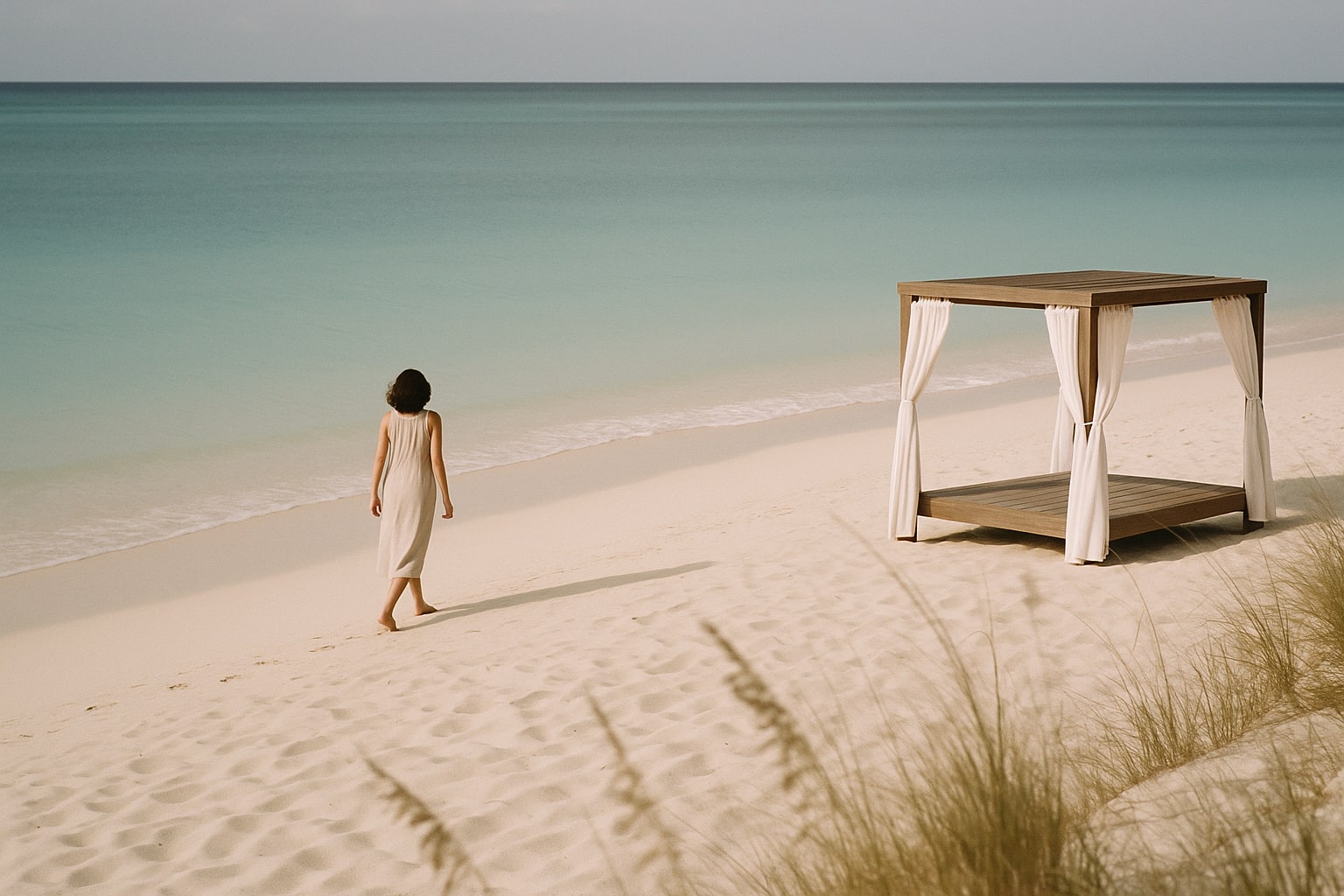
Turks and Caicos is the easiest honeymoon the Caribbean offers. The water is the clearest in the Atlantic basin, Grace Bay Beach is genuinely one of the best beaches on the planet, and the luxury hotels have figured out how to do consistency at scale. If you want a trip where the biggest decision each day is which pool to float in, this is the place.
The downside is real: TCI is not a culturally rich destination. Providenciales, where almost everyone stays, is a 38-square-mile island built almost entirely around tourism. The local dining scene outside of hotel restaurants is thin. Shopping is limited. There is no old town to wander, no market to get lost in, no bus to nowhere. If you need to feel like you are inside a real place, you will be bored by day three.
That is not a knock. It is just clarity about what the destination is for. Turks and Caicos is a backdrop for doing nothing together, extremely well.
When Should You Go?
December through April is the dry season. Temperatures hold between 75 and 84 degrees Fahrenheit, trade winds keep the humidity manageable, and rain is infrequent. This is also peak pricing season. Expect nightly rates at the top properties to run 20 to 40 percent higher from mid-December through mid-April compared to the summer months.
January through March is the most consistent weather window. The water is clearest in these months, visibility on the reef pushes 80 to 100 feet, and there are almost no rain days. February is also Valentine's season, so rates and occupancy peak hard. Book at least four months out if you want specific room categories.
May and November are the best value windows. The weather holds, the beaches thin out, and rates drop. Most years, May in TCI is indistinguishable from March in terms of what you actually experience on the ground. November is riskier, sitting at the tail end of hurricane season, but most years see no meaningful storm activity after mid-October.
Avoid August through October for a honeymoon. Hurricane season peaks in September. The risk is manageable with travel insurance, but the anxiety of tracking storm forecasts is not the honeymoon energy most couples want.
Getting There: What to Know
Providenciales International Airport (PLS) has direct flights from Miami, New York JFK, Charlotte, Boston, and Atlanta. Flight time from the East Coast is roughly two to three hours. From the West Coast, you will connect, usually through Miami or Charlotte. There are no nonstop options from Los Angeles or San Francisco currently, and the connection adds roughly two hours to each leg.
The airport is small. Arrival and customs typically take 30 to 45 minutes on a normal day. In peak season, December through February, customs lines can stretch to 90 minutes. Factor that into your arrival day planning and keep the first afternoon low-key.
From the airport to Grace Bay hotels, the drive is 10 to 15 minutes by taxi. Most hotels charge $25 to $35 for the transfer. Some properties handle transfers directly; worth confirming before you arrive.
Not sure which property is right for your style? We know the room-by-room differences at the top Grace Bay hotels and can match you to the right fit.
Take the quiz →Where to Stay: Honest Options for Honeymooners
Grace Bay has a concentration of good luxury hotels within a short stretch of beach. The water and beach quality is consistent across the strip, so the choice comes down to vibe, room category, and service philosophy. Here is an honest look at the main options:
Amanyara
Amanyara is not on Grace Bay. It sits on the northwest coast of Providenciales, on a quieter stretch of shoreline called Malcolm's Road Beach. This is an important distinction. The beach here is less groomed than Grace Bay and the snorkeling off the property is exceptional, including direct access to one of the healthiest coral reef sections in the Caribbean.
The property feels like a private compound: 40 pavilions spread across 18 acres, with no sense of hotel density. Common areas include a tennis center, fitness pavilion, three pools, and a dive center. The architecture is minimal, in the way that Aman properties do minimalism, which requires spending real money to make things look this empty.
Who it is for: couples who want maximum privacy, genuinely excellent diving and snorkeling, and no shared pool energy. The detached-pavilion format means you will almost never encounter other guests unless you seek them out.
Honest downside: it is the most expensive option on the island, typically starting above $2,000 per night for the entry pavilion category. It is also remote from Grace Bay, which matters if you want to walk to other restaurants or properties. And the beach, while beautiful, is not as swimmable as Grace Bay on days with any swell.
Six Senses Turks and Caicos
Six Senses opened its Turks and Caicos property on Providenciales in 2023, and it landed on Grace Bay itself, which means you get the brand's wellness-forward philosophy combined with direct access to the best beach on the island. The property has 60 residences and villas set across beachfront and garden plots, with a signature Six Senses Spa, zero-waste dining concept, and the brand's usual obsession with sleep quality and sustainability metrics.
The dining program is noticeably better than most Grace Bay competitors, sourcing from the on-site organic garden and local fishermen. The wellness programming, including sleep consultations, yoga, and spa circuit access, is genuinely useful rather than decorative. If you and your partner are the type to actually use a spa itinerary, this property delivers it without feeling clinical.
Who it is for: couples who want a top beach position with wellness built in, and who care about the quality of what they are eating as much as where they are sitting. Also strong for couples who want activity variety beyond beach and pool: the dive and water sports center is well-equipped.
Honest downside: the Six Senses design language is earthy and organic, which photographs well but can read slightly rustic compared to the polished-marble luxury of some competitors. If your visual reference point for luxury is gleaming hard surfaces and dramatic architecture, the natural materials and softer palette might feel less than you expected. Also a newer property, so the staff culture is still developing compared to hotels with decade-long teams.
COMO Parrot Cay
COMO Parrot Cay sits on its own private island, accessible by a 35-minute boat ride from the Providenciales marina. The island is 1,000 acres of mangrove, dune, and undeveloped beach. The resort itself occupies a small portion of the island, with 60 rooms and villas spread along the beach and through the casuarina forest inland.
The COMO brand trades on wellness and restraint. The spa here is one of the most genuinely good ones in the Caribbean, drawing repeat guests who come specifically for the ayurvedic and COMO Shambhala treatments. Dining is clean, high-quality, and slightly health-focused without being preachy about it. The beach on the resort side is quiet, protected, and the water is shallow enough for wading far out.
Who it is for: couples who want true seclusion and don't need access to Grace Bay or other restaurants. The private island setup means you are fully committed to the resort experience for the length of your stay. That is exactly what some couples want.
Honest downside: the boat transfer means you are locked in. If you want to explore Grace Bay restaurants or have the flexibility to wander, Parrot Cay is not the property for you. The island is also low-lying, and the rooms and villas are set back from the water rather than perched above it, so views are horizontal rather than dramatic. Some guests find the seclusion wonderful; others feel it becomes isolating by day four.
Grace Bay has the best beach in the Caribbean. The debate is whether you want to be on it, or on your own island across the water from it.
What to Do Beyond the Beach
The barrier reef running along Grace Bay is called the Caicos Barrier Reef, the third-largest coral barrier reef in the world at approximately 65 miles long. Smith's Reef, about a 10-minute walk east of the main hotel strip near Turtle Cove, is the easiest shore-diving entry point. Visibility regularly exceeds 60 feet. The reef is healthy enough that you will see elkhorn and staghorn coral alongside nurse sharks, eagle rays, and sea turtles on a typical morning snorkel.
The Turks Island Passage, a 22-mile-wide deep-water channel between the Caicos Banks and the Turks Islands, is one of the top 10 dive sites in the western Atlantic. Humpback whales pass through the passage between January and March on their migration route. Day boat trips run from Providenciales and take about 90 minutes each way. Whale-watching window is roughly January 15 through March 15.
Grand Turk, the capital island of the TCI, is a 45-minute flight or a day-trip ferry from Providenciales. It is a genuinely different place: a small, quiet island with colonial-era buildings, a main street called Front Street with local restaurants and bars, and one of the best wall dives in the Caribbean immediately offshore. For couples who want one afternoon of local character on their trip, Grand Turk delivers it without requiring a full itinerary pivot.
The Conch Farm on Providenciales is the only commercial conch aquaculture operation in the world. It is not exactly a tourist attraction, but it is oddly fascinating if you care about where your food comes from. The conch you eat at almost every restaurant in TCI was raised here.
Turks and Caicos rewards couples who know which property to book and which excursions are worth the half-day away from the beach. We have opinions on both.
Take the quiz →Food: What the Hotel Restaurant Reality Looks Like
TCI's dining scene has a structural limitation: almost everything good is inside a hotel. Grace Bay has a few independent restaurants, including Somewhere Cafe and Lounge on the beach strip, which serves reliable roti and seafood at lunch, and Coco Bistro, a more polished dinner option set inside a garden that gives it a slightly different energy than hotel dining. But neither competes with the quality of a good resort restaurant on a strong night.
The best meals in TCI tend to come from properties that take the food program seriously: Six Senses, with its local-sourcing philosophy, and COMO Parrot Cay, which runs a tight kitchen. Amanyara's restaurant is solid and the setting, overlooking the pool and the ocean, makes everything taste better.
Fresh conch is ubiquitous and genuinely good. Conch salad, made tableside at beach shacks with lime, onion, tomato, and pepper, is the thing you eat here that you cannot easily get elsewhere. The Queen Conch in TCI is harvested locally, not imported, and the freshness shows.
What Nobody Tells You About Turks and Caicos
The trade winds are real. From December through April, a 15- to 20-knot wind is normal on Grace Bay. This is what keeps the island from being humid and what gives the water its turquoise clarity. It also means that beach chairs blow over, umbrella poles require staking, and some couples find the constant breeze annoying after a few days. The north side of the Grace Bay strip is slightly more protected than the main hotel stretch.
The reef is close. At Amanyara especially, but also from Smith's Reef near the hotel strip, you are a 10-minute swim from live coral. This is genuinely rare in the Caribbean. Most Caribbean snorkeling involves a boat ride to get to anything worth seeing. In TCI, you walk in from the beach.
Grace Bay issandier and calmer than most Caribbean beaches. The sand is fine, white, and powder-soft underfoot rather than coarse. The bottom stays shallow and sandy for a long way out. There are no rocks in the water along the main beach stretch. For couples who have had rocky or seaweed-heavy Caribbean experiences, Grace Bay is a genuinely different experience.
The currency is the US dollar and the official language is English. There are no visa requirements for US citizens and no entry tax. For American couples, TCI is about as logistically frictionless as an international destination gets.
Turks and Caicos vs. the Maldives: The Question We Get Every Month
Couples choosing between TCI and the Maldives are often choosing between two fundamentally different experiences. The Maldives is about overwater architecture, extreme seclusion, and island-hopping across a vast atoll network. TCI is about beach accessibility, Caribbean ease, and shorter travel days from the US East Coast.
If you want overwater bungalows, the Maldives wins by definition. TCI has no overwater villas. If you want a shorter flight, less time zone disruption, and the same quality of water, TCI is the better call. Our Maldives honeymoon guide covers the overwater side of that comparison in detail. And if a quiet Caribbean island with a very different character appeals, the Nevis guide is worth reading alongside this one.
Frequently Asked Questions
When is the best time to honeymoon in Turks and Caicos?
December through April is the dry season and the most reliable weather window. January through March gives you the clearest water and fewest rain days, though prices peak in February. May and November are the sweet spots for value: weather holds, rates drop 20 to 30 percent, and the beaches are noticeably less crowded. Avoid August through October, which is hurricane season.
Is Turks and Caicos worth it for a honeymoon?
Yes, if you want a genuinely relaxed, beach-forward trip with excellent water and low logistical friction. TCI is one of the few Caribbean destinations where the luxury hotels are consistent enough that you can trust the experience without obsessing over room selection. The downside: it is expensive, limited in cultural depth, and the dining scene outside of hotel restaurants is thin.
How many days should you spend in Turks and Caicos for a honeymoon?
Seven nights is the sweet spot. Five nights feels rushed once you account for travel days. Ten nights is better if you want to add a day trip to the Turks Island Passage or Grand Turk. Most couples find that Grace Bay delivers everything they came for by day four, so build in at least one off-property excursion.
What is the best area to stay in Turks and Caicos?
Grace Bay on Providenciales is where almost all honeymooners stay, and with good reason: it has the best hotels, a protected reef just offshore, and calm water year-round. The Grace Bay strip is about 12 miles long and walkable between most properties along the beach. The north side of the bay, near Leeward Going Through, has slightly less foot traffic than the main hotel cluster.
What is the water like in Turks and Caicos for snorkeling?
Excellent. The barrier reef running along Grace Bay is one of the healthiest in the Caribbean, with visibility regularly reaching 60 to 100 feet. Smith's Reef, accessible directly from the beach at Turtle Cove, is the easiest entry point. The Turks Island Passage nearby is one of the top 10 dive sites in the Atlantic, though it requires a boat trip of about 90 minutes each way from Providenciales.