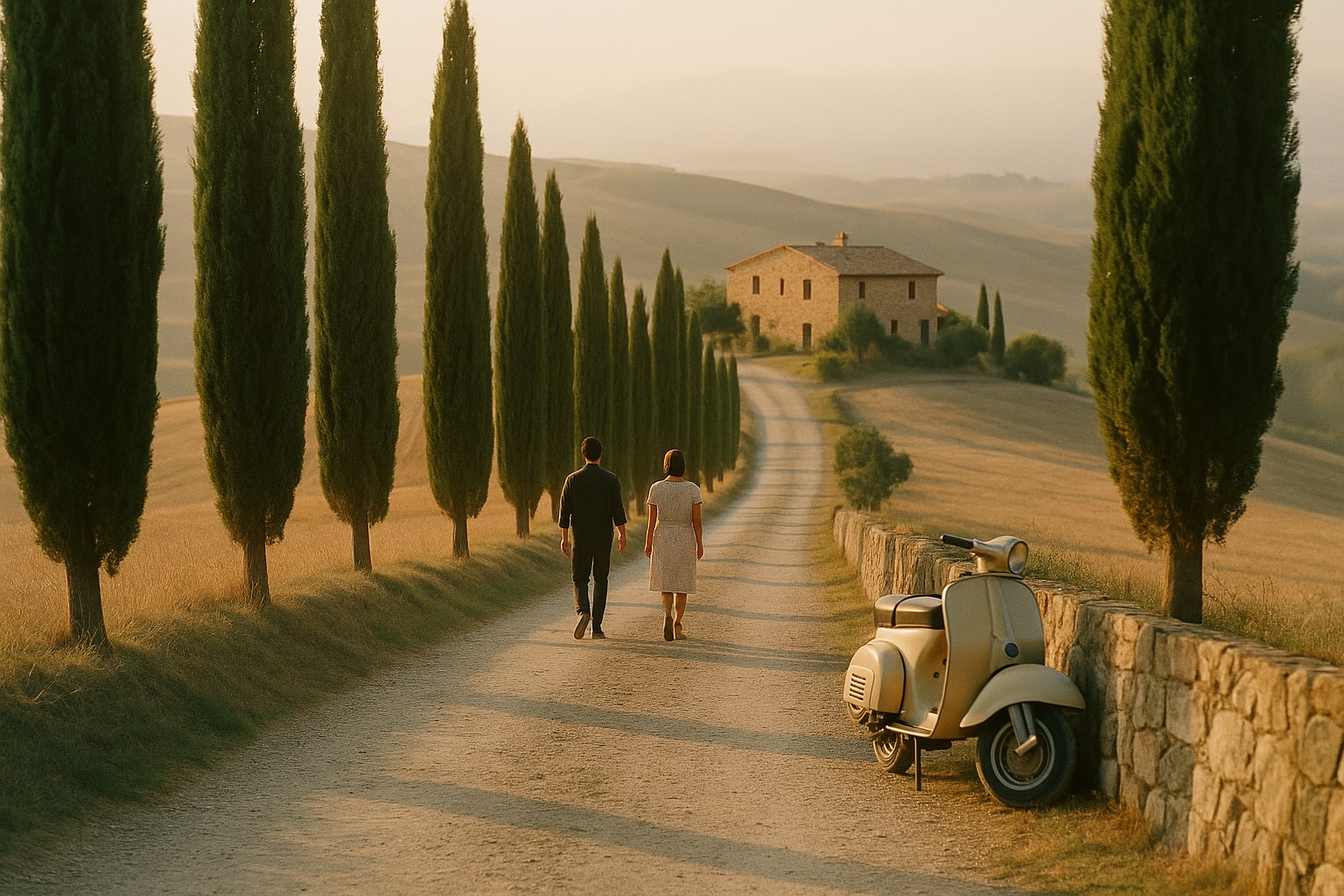
Tuscany is the Italian countryside that everyone pictures and the one that actually delivers. For a honeymoon, the question is not whether to go but which version of Tuscany fits your pace: a private estate in the Val d'Orcia where you never need to leave the grounds, a cliff-edge spa hotel with thermal pools fed by natural hot springs, or a restored Relais and Chateaux mill in the olive groves an hour from the sea.
Tuscany is the Italian countryside that everyone pictures and the one that actually delivers. For a honeymoon, the question is not whether to go but which version of Tuscany fits your pace: a private estate in the Val d'Orcia where you never need to leave the grounds, a cliff-edge spa hotel with thermal pools fed by natural hot springs, or a restored Relais and Chateaux mill in the olive groves an hour from the sea.
The region is large enough that two couples could go to Tuscany the same week and come back with completely different trips. The cypress trees and rolling wheat fields are everywhere. The difference is in the base you choose and the pace you set.
What Tuscany Actually Is (and What It Is Not)
Tuscany is a region, not a single place. It stretches from Florence in the north down through Chianti wine country, past Siena, through the UNESCO-protected Val d'Orcia, and all the way to the Maremma coast in the south. For a honeymoon, most couples focus on the middle section: the Val d'Orcia and the hill towns around Montalcino and Montepulciano.
This is correct instinct. The Val d'Orcia is what you picture when you think of the Tuscan countryside. Wheat-colored hills, lone cypress trees on ridgelines, medieval village profiles on the horizon. The light in late afternoon is genuinely something else.
What it is not: easy to navigate without a car. Nearly every worthwhile property outside of Florence and Siena requires a rental car or pre-arranged transfers. The drives are beautiful, but factor in about 20 to 45 minutes between most properties and the nearest town. This is not a problem once you accept it. It becomes a problem if you arrive expecting Italian city-center convenience.
The Maremma coast, in southern Tuscany, is a different animal entirely: a rugged, less-polished stretch of cliffs and thermal springs that draws couples who specifically want the thermal hot springs experience. Worth knowing about if that is your thing.
When to Go
Late April through early June is the best window for a Tuscany honeymoon. The hills are still green before the summer heat browns everything, wildflowers are out across the Val d'Orcia, and the tourist pressure at places like Montepulciano and Pienza is manageable. Temperatures in May sit comfortably in the mid-60s to low 70s Fahrenheit.
September and October are the second-best window. Harvest season, grape stomping if that matters to you, and cooler evenings after a warm day. The countryside looks different in fall: golden and dry, with a haze over the hills that photographers chase. Peak crowds are gone, and the Brunello di Montalcino wineries are actively harvesting.
July and August are legitimate if you book well in advance and know what you are signing up for. The heat in the Val d'Orcia sits above 90 degrees Fahrenheit most afternoons. The pool becomes the default activity from noon to five. Properties like Rosewood Castiglion del Bosco are nearly full, and booking windows open months earlier. Some couples love this version. Others find it limiting.
January through mid-March is off-season. Most estate properties close entirely, with the exception of their villa inventory. Castello di Velona, for example, stays open through winter, but the thermal baths are especially atmospheric in cold weather. If you want Tuscany almost entirely to yourselves, this window works.
Getting There
Florence's Amerigo Vespucci Airport is the closest gateway for the Val d'Orcia region, roughly an hour's drive from most properties. Pisa has a larger international airport with more direct transatlantic connections, adding about 90 minutes to the drive. Rome Fiumicino is a viable option for properties in the southern Val d'Orcia and Maremma, with a 2 to 2.5-hour drive. If you are considering combining Tuscany with the Amalfi Coast, the Rome to Amalfi pairing guide covers how to structure that itinerary without spending half the trip on buses.
Most high-end properties will arrange private transfers from any of these airports at an additional cost. Rosewood Castiglion del Bosco's transportation team handles airport pickups for guests who prefer not to navigate the winding roads to the property themselves.
Where to Stay: Three Properties Worth Knowing
Rosewood Castiglion del Bosco, Montalcino
This is the fullest version of a Tuscany honeymoon. A 5,000-acre estate in the Val d'Orcia, 20 minutes from Montalcino, with 42 suites and 11 private villas, an on-property winery producing Brunello di Montalcino, Italy's only private golf club, a cooking school, a spa, and a Sunday evening festival where local vendors line the estate's cobblestone streets.
The entry-level accommodation is a Junior Suite, and it is genuinely generous: walk-in shower, separate soaking tub, terrace with vineyard views, bath products from the Santa Maria Novella pharmacy in Florence. In winter, turndown includes lit candles and a bottle of Rosso di Montalcino. The Borgo Suites, one step up, add a corner terrace and more space.
For couples considering a villa: each of the 11 villas comes with a private gate entrance, a Land Rover Defender, and a Mamma in Villa who handles breakfast, light lunch, and basic household management. The half-board package includes one restaurant meal per day, either at the Michelin-starred dining room or in your villa with a private chef. Pop-up dinners in the vineyards are available seasonally.
The honest downside: this is not the place if you want to spend your honeymoon exploring Tuscany's towns and cities. The estate is the experience. It is remote by design, the winding roads to the property are not casual, and some guests describe it as an Americanized version of Tuscany rather than an authentically local one. If you are going to Tuscany to shop in Siena's markets and eat in Pienza's trattorias every night, Rosewood Castiglion del Bosco is the wrong base. If you are going to exhale on a private terrace with a glass of Brunello and not leave the grounds for four days, it is the right one.
Villas-only from January 8 through March 20. During that window, breakfast is included in all villa stays. Villas require a minimum of one night in December and three nights during June and July peak season.
Castello di Velona, Montalcino
An 11th-century fortress on a hilltop above Montalcino's vineyards, Castello di Velona pairs medieval architecture with thermal baths fed by natural hot springs. This is a genuinely different offering from Rosewood: smaller, focused on wellness, and with a winery on the estate producing its own olive oil. Turkish baths, a panoramic sauna, and indoor and outdoor thermal pools make this the choice for couples who want the spa to be the core of the trip rather than one activity among many.
Truffle hunting, cooking classes, and blindfolded wine tastings are all offered from the property. The hilltop position gives 360-degree views of the Val d'Orcia and the vineyards of Brunello country.
The honest downside: with fewer rooms and a more wellness-forward identity, Castello di Velona has a quieter, more intimate atmosphere that some couples find perfect and others find a bit sleepy. The thermal focus means the programming skews toward relaxation rather than adventure. If you want both the thermal experience and more active days, plan to drive to Montalcino and the surrounding towns, which are close enough to do easily.
Il Bottaccio, Montignoso (Northern Maremma Coast)
Il Bottaccio is an 18th-century mill converted into a Relais and Chateaux property, set in olive groves between the Apuan Alps and the Ligurian Sea in Montignoso, in the northern Maremma. This is the outlier on this list, and intentionally so: it is the Tuscany hotel for couples who want something more secluded and less visited than the Val d'Orcia circuit.
The rooms feature beamed ceilings, Persian rugs, and Ferragamo toiletries. The cooking and the food are the other draw: as expected from a Relais and Chateaux property, meals here are consistently exceptional. The kitchen focuses on local Tuscan ingredients, and the herb gardens visible from several rooms supply much of what ends up on the plate.
From Il Bottaccio, couples can arrange yacht cruises along the coast, art classes, and day trips to Carrara's marble quarries about 20 minutes away. The property also has a spa and hammam. The Cinque Terre is reachable in under two hours.
The honest downside: this is a small property in a genuinely remote location. It is not the right choice if you want easy access to Tuscany's famous interior hill towns. The Val d'Orcia is about two hours away, and the Chianti region is further still. Il Bottaccio rewards couples who want total privacy and coastal access over countryside panoramas.
Planning a Tuscany honeymoon? Aisle to Away works with Rosewood Castiglion del Bosco, Castello di Velona, and other top properties as a preferred partner, which means perks stacked on top of your rate.
Tell us where you want to goWhat to Do: Beyond the Hotel Grounds
If you are staying in the Val d'Orcia, the two towns worth driving to are Montalcino and Pienza. Montalcino is the wine town: a small hilltop fortress with a handful of good enotecas and the cellars of Brunello producers within easy reach. Pienza is the Renaissance ideal city, designed by Pope Pius II in the 15th century, with a cathedral square that looks almost too well-composed to be real. It is about 30 minutes from Montalcino and worth an afternoon.
Siena is an hour from the Val d'Orcia and a full half-day at minimum. The Piazza del Campo, the Duomo, and the Pinacoteca Nazionale are all genuinely worth the trip. Do not go on a day when the Palio horse race is scheduled (July 2 and August 16); the crowds are extraordinary and the city is completely given over to the race.
For wine, any property in Brunello country can arrange a private tasting at one of the historic Montalcino estates. The wine itself is one of Italy's most age-worthy reds, and the tasting rooms in this part of Tuscany tend to be excellent. Banfi and Biondi-Santi are the two names with the most historical significance; smaller producers like Salvioni and Le Chiuse offer more intimate experiences.
Truffle hunting in fall season, typically September through December, is available from most properties. The ones worth booking are guided by local truffle hunters with dogs, not theatrical productions designed for tourists. Ask the property concierge whether the truffle hunter on their roster actually hunts commercially or only does hotel tours.
What to Skip
San Gimignano is on every Tuscany itinerary and is genuinely beautiful for about 40 minutes, after which the combination of crowds and souvenir shops becomes hard to justify. In high season it is actively unpleasant. If you want medieval towers and hill town atmosphere, Monteriggioni is smaller, less visited, and five minutes off the Siena autostrada.
Cooking classes with theatrical elements, where a costumed Italian grandmother leads thirty tourists through making fresh pasta, are not the worst thing in the world but they are not a genuine experience. Most high-end properties in Tuscany run cooking classes taught by their actual kitchen staff in the actual hotel kitchen. Those are worth doing; the tourist-focused versions in town are not.
A Note on Viesca Toscana
For couples or small groups looking for a private villa experience rather than a hotel stay, Viesca Toscana is worth knowing about. It is a collection of villas and suites in the Tuscan countryside, each with a private pool and garden, anchored by La Corte Spa, which offers olive oil treatments, wine therapy, sound baths, meditation, and yoga. The wellness programming is more holistic and unusual than most hotel spas, and the privacy of a standalone villa is different from a hotel suite even a very good one.
Practical Notes
You need a car. This is not negotiable outside of Florence and Siena. The best properties are on private roads or down unpaved lanes that no taxi driver from the airport will want to navigate without advance booking. Arrange a rental car through the property or through a reputable local car service, and confirm GPS coordinates rather than just the address, because many estate properties do not appear correctly in standard mapping apps.
Dress codes at dinner exist and are enforced at the higher-end properties. Smart casual at minimum. At Terme di Saturnia, proper attire is required in the main dining room; the library bar is a workaround if you prefer to eat in robes after a day in the thermal baths.
The shoulder season rates in April, May, and October are meaningfully lower than July and August peak. The experience is arguably better. This is one of the few Italian destinations where the timing and the value argument point in the same direction.
Frequently Asked Questions
Is Tuscany a good honeymoon destination?
Tuscany is one of the strongest honeymoon destinations in Europe for couples who want a mix of landscape, wine, food, and genuine seclusion without sacrificing quality of accommodation. The Val d'Orcia in particular has a concentration of estate hotels that rival anything in France or Spain for romantic setting, and the food and wine are in a class by themselves.
When is the best time to visit Tuscany for a honeymoon?
Late April through early June is the strongest window: the hills are green, wildflowers are across the Val d'Orcia, and temperatures are comfortable without the July and August heat. September and October are equally good for different reasons: harvest season, Brunello producers actively working, golden light, and post-peak crowds. July and August work but require advance booking of six months or more for the best properties.
What is the best hotel in Tuscany for a honeymoon?
Rosewood Castiglion del Bosco near Montalcino is the fullest luxury estate experience: 5,000 acres, a private winery producing Brunello di Montalcino, a Michelin-starred restaurant, and 11 private villas with personal Mamma in Villa service. For couples who want the thermal hot springs experience combined with wine country setting, Castello di Velona is the alternative, with indoor and outdoor thermal pools and medieval architecture above the Montalcino vineyards.
Do you need a car for a Tuscany honeymoon?
Yes, if you are staying anywhere outside Florence or Siena. Nearly all the estate properties in the Val d'Orcia require a car or arranged transfer, and many are down unpaved private roads that standard taxis will not navigate without advance arrangement. Most properties can arrange private transfers from Florence, Pisa, or Rome airports; confirm this when booking if you prefer not to drive.
How many days do you need for a Tuscany honeymoon?
Five to seven nights gives you enough time to settle into one or two bases without feeling rushed. Three nights at a Val d'Orcia estate like Rosewood Castiglion del Bosco, followed by two or three nights somewhere with coastal access or a different landscape, is a common structure. Tuscany rewards slower travel. Trying to cover Florence, Chianti, the Val d'Orcia, and the coast in a week means you are driving most of the time.
What is there to do in the Val d'Orcia for a honeymoon?
From a Val d'Orcia base, the strongest activities for honeymooners are private wine tastings at Brunello producers around Montalcino, truffle hunting in fall season, cooking classes at the hotel, half-day drives to Pienza and Montalcino, and simply doing very little in a setting that makes doing very little feel worthwhile. Most estate properties also have spas, pools, and enough on-property programming that leaving the grounds never feels necessary.
If you want a second opinion on where to base your Tuscany honeymoon, that is exactly what we do.
Take the quiz →